Southern Dallas–Fort Worth · North Texas

The North Texas Lawn Grass Guide

Every grass worth growing in the southern DFW metroplex — compared across sun and shade, drought, heat, cold, traffic, looks, maintenance and cost. Written for Blackland clay, brutal summers, and twice-weekly watering rules.

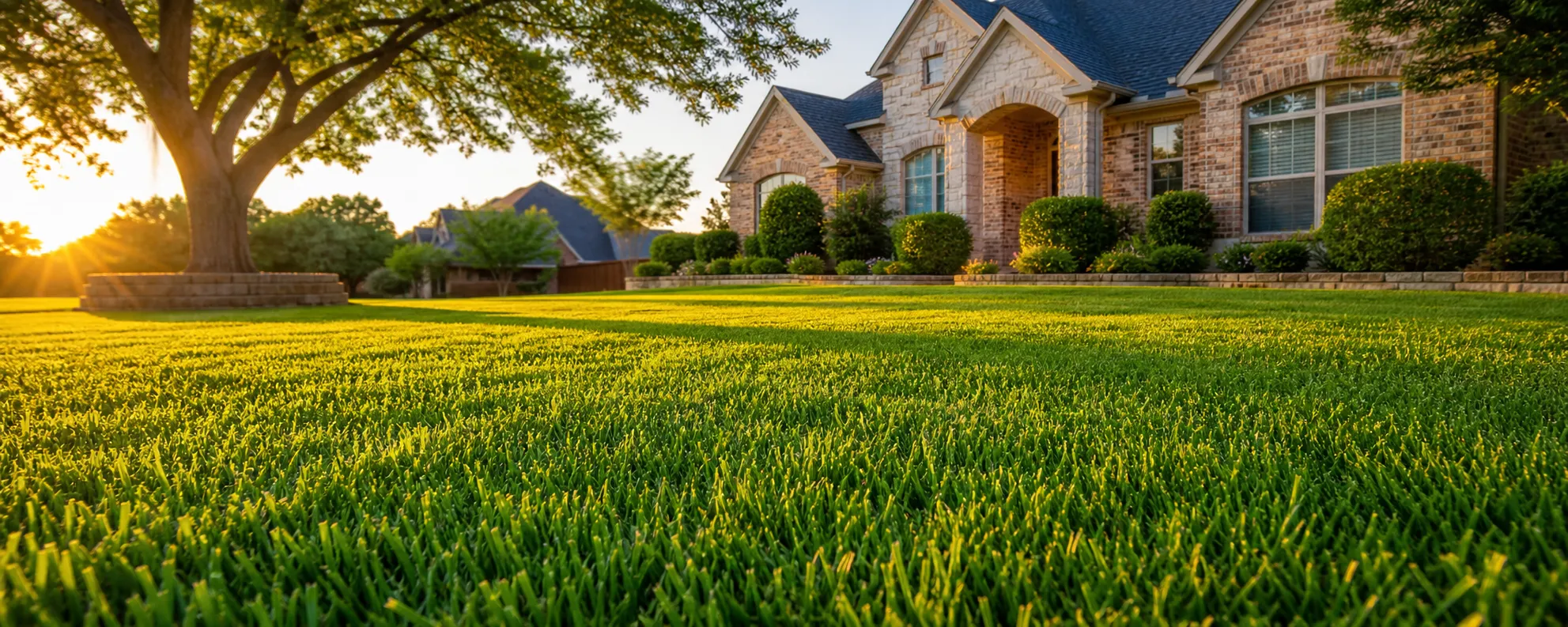
A lush green North Texas suburban lawn at golden hour
Hardiness zone
USDA 8a/8b — treat as borderline
Heat
AHS zone 9 · 120–150 days ≥ 86°F
Rainfall
~37 in/yr, unevenly distributed
Soil
Blackland Prairie clay · pH 7.4–8.4
Frost-free
~240 days · last ~Mar 21, first ~Nov 14
Watering
Twice weekly, no sprinklers 10a–6p

01 — Start here

Quick-pick decision guide

Start with one number: how many hours of direct sun does the area get in summer? Sun is the single biggest filter — it decides the shortlist before any other preference.

Your situationBest pickRunner-up / notes
Full sun (6–8 hr), want lush + durable + value, kids and dogsHybrid bermuda — TifTufTahoma 31 for maximum freeze insurance; Tifway 419 to save money
Full sun, lush carpet with the least ongoing work, low trafficZoysia — PalisadesZeon or Zorro for maximum fineness. Accept higher cost and slow fill-in
Full sun, tight budget, seeding it yourselfSeeded bermuda — Yukon or RivieraCold-hardy seeded types; a full lawn in one season
Full sun, low-water or rural, fine with winter dormancyBuffalograss ('Prairie') or HabiturfNative, thrives on Blackland clay — but do not overwater it
Moderate shade (4–6 hr), shade tolerance and fast fill matter mostSt. Augustine — Palmetto or Del MarRaleigh for cold-hardiness; accept winterkill and chinch-bug risk
Moderate shade (4–6 hr), cold resilience and a fine look matter mostZoysia matrella — Zorro or ZeonSlower and pricier to establish; needs the higher end of the light range
Deep, north-facing or cool shade (~3–4 hr), want year-round greenTurf-type tall fescue (blend)Cool-season: expect fall reseeding and summer brown-patch management
Dense shade, under ~3 hr direct sunNo turf — sedges, groundcover, or mulchCarex texensis for dry shade; Carex perdentata for sun or shade

02 — If you read nothing else

Three recommendations for a typical southern-DFW homeowner

  • 01 · Full-sun, do-it-all default

    TifTuf bermuda

    Best-documented water efficiency (roughly 38% less than Tifway), top Texas turf-quality scores, fast self-repair under traffic, earliest spring green-up, and the widest availability. Needs frequent mowing and genuine full sun.

  • 02 · Full-sun, lowest ongoing maintenance

    Palisades zoysia

    A dense, weed-resistant carpet at rotary-mower height. Less mowing, less fertiliser, and it will not invade beds. Cold-hardy. Costs more up front and fills in slowly.

  • 03 · Shaded lawn

    Palmetto / Del Mar, or Zorro / Zeon

    St. Augustine for maximum shade tolerance, zoysia matrella for maximum cold resilience. Below roughly 3–4 hours of sun, stop fighting it and switch to groundcover.

03 — Context

Why North Texas is different

Everything in this guide flows from four regional realities. Understand these and the grass recommendations become obvious.

2.1

Mild winters, punctuated by rare brutal freezes

Most of southern DFW is zone 8b (average annual extreme low 15–20°F); colder rural fringes are 8a. The freeze that actually decides grass selection is Winter Storm Uri in February 2021 — single digits for about six straight days, causing widespread St. Augustine winterkill across the metroplex. Choose grass that survives the once-a-decade polar outbreak, not the average winter.

Cold-hardiness, most to least: buffalograss and zoysia → cold-hardy hybrid bermudas (Tahoma 31, Latitude 36, NorthBridge) → common bermuda → TifTuf and most hybrids → St. Augustine and centipede.
2.2

Rain arrives as feast, then famine

The annual normal is about 37 inches, but it is unevenly distributed. Spring is wettest — May averages ~4.8 in, the rainiest month, which makes establishment easy. July and August are driest at ~2.1 and ~2.2 in, so peak heat coincides with minimum rain and maximum irrigation demand. October brings a secondary wet peak (~4.4 in).

Wet, mild springs make grass establish easily. Hot, dry late summers kill un-irrigated lawns.

2.3

Heavy alkaline clay, and what it rules out

Blackland Prairie clay dominates — the signature soil is Houston Black, the Texas state soil: 40–80% cracking clay, pH 7.4–8.4 from free calcium carbonate, extreme shrink-swell, poor drainage. The western edge (west Tarrant, Parker, Wise, Hood) is sandier, slightly acidic Cross Timbers loam instead.

High pH disqualifies centipedegrass and bahiagrass outright. You cannot economically lower Blackland pH — it is buffered by built-in carbonate. Choose a tolerant grass rather than fighting the soil, and fix mild iron chlorosis with chelated iron.

2.4

Water restrictions reward drought-tolerant grass

Nearly every DFW city enforces no sprinklers between 10 a.m. and 6 p.m., plus twice-weekly assigned watering days that tighten in drought stages. Fort Worth, Dallas, Arlington and Cedar Hill all run address-based twice-weekly schedules; Mansfield and Midlothian vary by drought stage. Hand-held hose, drip and soaker hoses are usually exempt.

Bermuda, zoysia and buffalograss stay viable under these limits. St. Augustine is the hardest to keep alive in a drought-stage summer.

04 — The grasses

What each one actually is

  • Bermudagrass

    6–8 hr · full sun

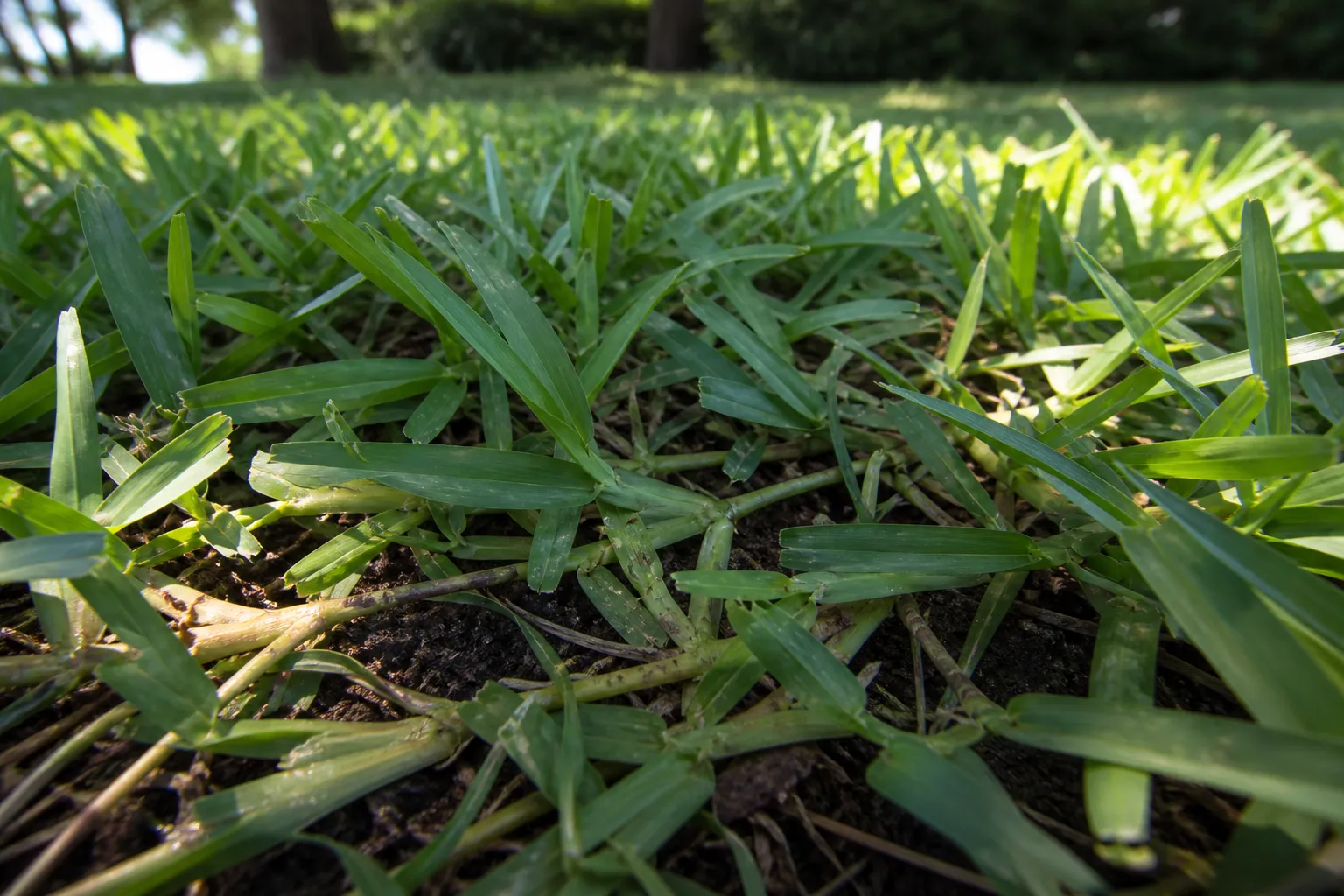
    Bermudagrass

    The full-sun workhorse. Best-in-class drought tolerance, heat tolerance, traffic tolerance and self-repair, and the only warm-season option here that establishes cheaply from seed. Pays for it in mowing frequency and an absolute intolerance of shade.

    Pick: TifTuf for the default; Tahoma 31 for freeze insurance; Yukon or Riviera from seed.

  • Zoysiagrass

    5–6 hr (japonica) · 4–5 hr (matrella)

    Zoysiagrass

    A dense, weed-resistant carpet that asks for less mowing and less fertiliser than bermuda and will not invade beds. The trade is money and patience: it costs more to put in and fills gaps slowly, so damage takes a season to disappear.

    Pick: Palisades for rotary-mower height; Zorro or Zeon for a finer blade and more shade.

  • St. Augustinegrass

    4–5 hr · the shade option

    St. Augustinegrass

    The most shade-tolerant warm-season turf that still reads as a lawn, and the fastest to fill in. It is also the least drought-tolerant and the least cold-hardy — Uri killed it across the metroplex in 2021 — and it cannot be seeded, only sodded or plugged.

    Pick: Palmetto or Del Mar for maximum shade; Raleigh for maximum cold-hardiness.

  • Buffalograss and native blends

    6–8 hr · full sun

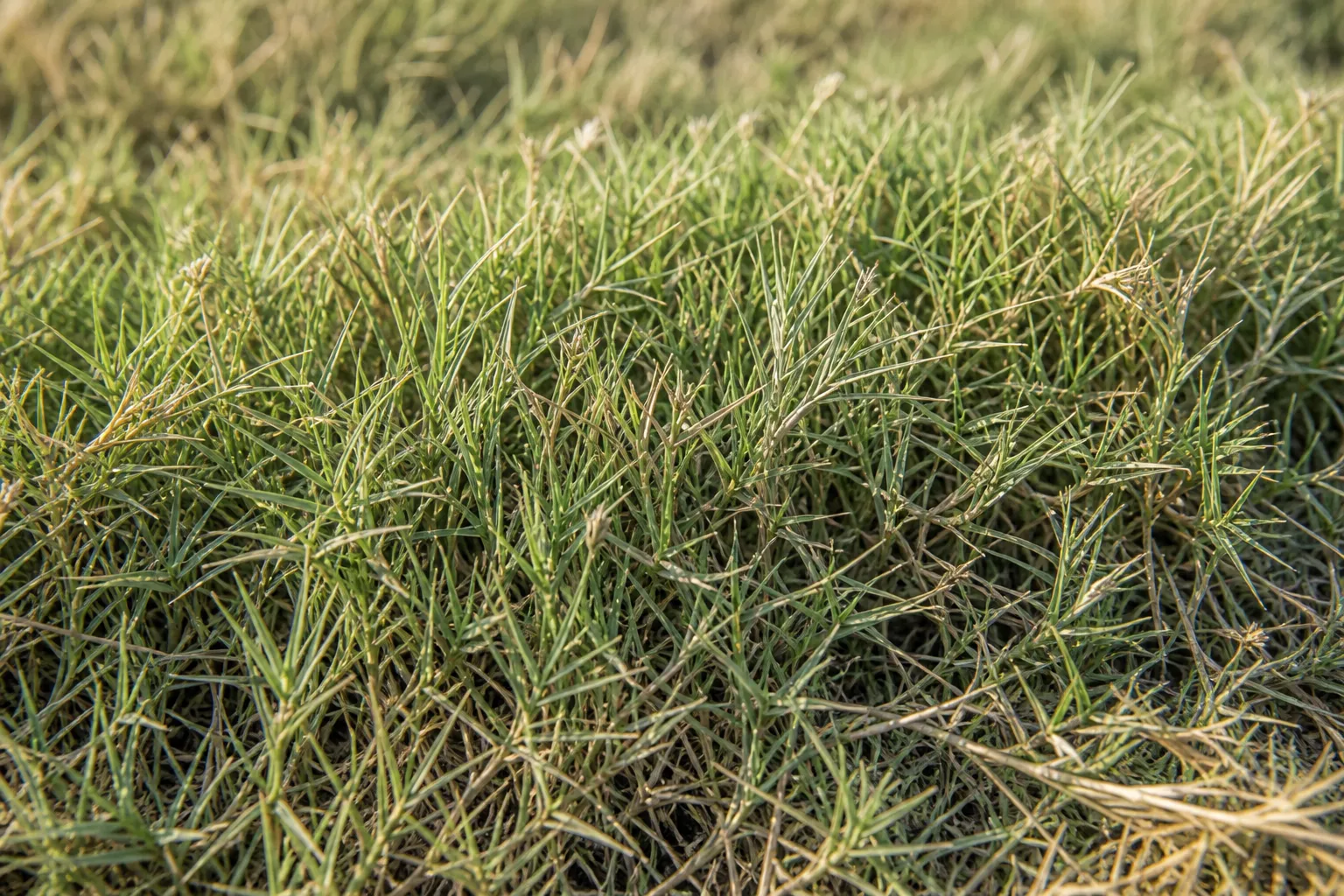
    Buffalograss & natives

    The native. Lowest water requirement of anything here, thrives on Blackland clay, and asks for almost no nitrogen. It will not take traffic, and the most common way to kill it is to water it like a bermuda lawn.

    Pick: 'Prairie' buffalograss, or a Habiturf native blend.

  • Turf-type tall fescue

    3–4 hr · deep shade

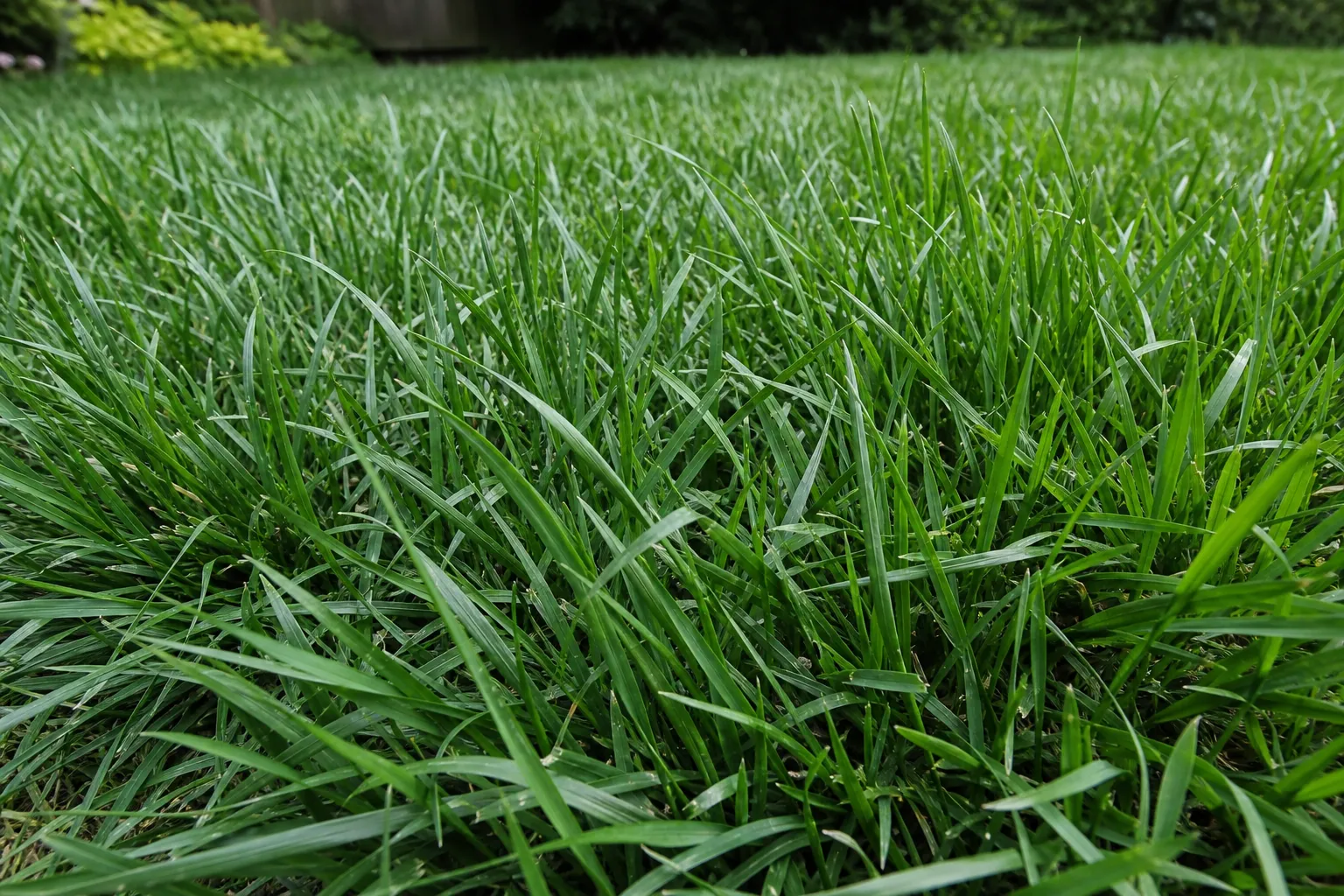
    Turf-type tall fescue

    The cool-season exception, and the answer when a north-facing or heavily canopied area gets too little sun for anything warm-season. Stays green through winter. In exchange it has no self-repair, needs reseeding each fall, and struggles through a North Texas August.

    Pick: A turf-type blend, overseeded every autumn.

05 — Compare

All grasses, all variables

Scale runs ★ poor to ★★★★★ excellent. “Min sun” is approximate direct hours per day needed to persist as turf in DFW. Centipede is deliberately absent: it fails on alkaline Blackland clay.

GrassMin sun (hr)DroughtHeatCold 8a/bTrafficSelf-repairTextureMow ht (in)N (lb/yr)EstablishRel. cost
Bermuda — hybrid (TifTuf/Tahoma)6–8★★★★★★★★★★★★★★★★★★★★★★★★Fine0.5–22–6Sod/sprigPremium
Bermuda — Tifway 4196–8★★★★★★★★★★★★★★★★★★★★Fine0.75–1.52–6Sod/sprigLow
Bermuda — seeded (Yukon/Riviera)6–8★★★★★★★★★★★★★★★★★★★★★Med1–22–6Seed/sodLowest
Zoysia japonica (Palisades)5–6★★★★★★★★★★★★★★★★★★★ slowMed-coarse1.5–2.51–3Sod/plugHigh
Zoysia matrella (Zorro/Zeon)4–5★★★★★★★★★★★★★★★★★ slowFine1–1.51–3SodPremium
St. Augustine (Palmetto/Raleigh)4–5★★★★★★★★ Uri risk★★★★★Coarse2.5–42–4Sod/plugHigh
Buffalograss ('Prairie')6–8★★★★★★★★★★★★★★★★★★★Fine2.5–40–2Seed/sod/plugLow–Mid
Habiturf (native blend)6+★★★★★★★★★★★★★★★★★★★★Fine3–40–2Seed/sodMid
Tall fescue (TTTF)3–4★★★★★★★★★★★★ noneMed-coarse3–42–4SeedLow

06 — Water

What each grass actually drinks

GrassGreen & lushMerely surviveStrategy
Buffalograss~0.5"/wkAlmost none once establishedMost drought-tolerant; native
Bermuda~1–1.5"/wkVery little — goes dormantMost drought-tolerant common turf; recovers well
Zoysia~1–1.25"/wkLow — dormant, then recoversDrought-tolerant; slow to recover but survives
St. Augustine~1.25–1.5"+/wkPoor — does not survive dormancy wellLeast drought-tolerant; short recovery window

AgriLife guidance is to water deeply and infrequently — at most once or twice a week in summer, to about 6 inches of depth, ideally only when the grass shows stress (footprints linger, blades do not spring back). General target is ¾–1½ inches per week for peak appearance.

07 — Cost and establishment

What it takes to put it in

GrassSod material (per pallet, ~450 ft²)Installed (per ft²)
Bermuda~$250–380~$0.50–0.85
Zoysia~$400–550~$0.90–1.25
St. Augustine~$300–450~$0.67–1.00
Buffalograss~$1/ft² materialvaries

A full professional install — removing old sod, prep, sod and labour — commonly runs about $1–2 per square foot, or roughly $1,000–3,000 for an average yard. Bermuda seed runs $3–10 per pound.

Plant warm-season grass in late spring to early summer, once soil hits 70–80°F, and at least 90 days before first frost. Never establish warm-season grass in fall — it will not root before dormancy, and winterkill follows.

08 — Calendar

North Texas maintenance year

Soil temperature at 2 inches, not the calendar, triggers the key jobs — pre-emergents especially.

Jan
Dormant. Plan and soil-test. Spot-control winter weeds (henbit, Poa annua). No fertiliser.
Feb
Apply spring crabgrass pre-emergent when soil at 2" hits 50–55°F — often late Feb to mid-March. Do not wait for the calendar.
Mar
Finish pre-emergent. Last frost ~Mar 21. First mow at green-up. Best month to prep for new sod.
Apr
First fertiliser only after full green-up (~0.5–1 lb N). Prime planting window opens. Spot-treat broadleaf weeds.
May
Peak rain, easy establishment. Core-aerate and dethatch during active growth. Second fertiliser if on a programme.
Jun
Hot and dry begins. Spoon-feed nitrogen. Start deep, infrequent irrigation. Scout chinch bugs and grubs.
Jul
Driest and hottest — irrigation-critical. Deep watering 1–2×/wk, never 10a–6p. Mow frequently at proper height.
Aug
Scout chinch bugs, armyworms, mites. Last main fertiliser by mid-August. Start fall pre-emergent for Poa annua late Aug.
Sep
Stop high nitrogen around mid-September to harden off. Confirm fall pre-emergent. Watch for large and brown patch as nights cool.
Oct
Fall potassium winterizer (low N) for cold hardiness. Winter overseed window ~Oct 1–15 if desired.
Nov
First frost ~Nov 14 and dormancy. Final mow, remove leaves, reduce or stop irrigation.
Dec
Dormant. Minimal mowing. Plan, and avoid traffic on frozen turf.

Cheat sheet. Spring pre-emergent at soil 50–55°F (late Feb to mid-March) · fall pre-emergent late Aug to early Sept · fertilise only after green-up through summer, stopping around mid-September · potassium-only winterizer in October · aerate and dethatch in May · overseed October 1–15.

09 — Field notes

Questions & field notes

Real questions asked while working this lawn, with distilled answers — captured from working sessions as they happen. Newest first. Unlike the guide above, this section is an ongoing log, not part of the 2026 snapshot.

2026-09-13When will the crabgrass in my lawn start to go dormant?

It doesn't go dormant — it's a summer annual, so it dies outright. Crabgrass keeps growing and setting viable seed right up until frost kills it, with no reliable slowdown beforehand. The median first 32°F freeze at DFW Airport is ~Nov 22 (NWS Fort Worth, 1991–2020 normals), and the southern metro typically runs a few days earlier — so expect browning in early-to-mid November and nothing left by Thanksgiving. The spread is wide: the earliest first freeze on record is Oct 22. Practical result — skip post-emergent now, since quinclorac loses efficacy on mature tillered plants that only have weeks to live. Note also that the fall pre-emergent in the calendar targets winter annuals (Poa annua, henbit) and does nothing for crabgrass; crabgrass prevention is the spring application at 2″ soil temp ~50–55°F.

2026-09-13Is there a good time coming up to overseed the bermuda in my front lawn?

No — that window closed in June. Seeded bermuda goes down late May–mid-June at sustained 2–4″ soil temps of 65°F or higher, and needs roughly 60–90 days of active growth to build the stolon and rhizome mass that actually carries it through winter. Seeding now leaves only ~70 days to frost, minus 2–3 weeks to germinate — not enough, and immature seedlings are precisely what failed across the region in Feb 2021. Next window: mid-April–June 15, 2027 (Oklahoma State suggests sowing by May 1 for maximum hardening time), at ~1–2 lb seed/1,000 ft² of Yukon or Riviera. One conflict to plan around: the spring crabgrass pre-emergent blocks bermuda seed too, so 2027 is either pre-emergent or seeding, not both — if seeding, control crabgrass with quinclorac instead and finish spraying ~4 weeks before sowing. Until then: no nitrogen (past the mid-September cutoff), a potassium-only winterizer 4–6 weeks before frost, mow at 1–2″, final mow in November.

2026-09-13Same question for the tall fescue in my back lawn?

Yes — Sept 1–Oct 15 is the window and we're inside it, but wait two to three weeks anyway. DFW is 58+ days without measurable rain, highs still in the 90s–100s, with D1–D2 drought; fescue needs the top inch of soil continuously moist for 10–14 days to establish (seed sprouts in 5–14 days at 50–70°F soil). Target late September through ~Oct 10; Oct 15 is the hard back edge. Rate 6–10 lb/1,000 ft² for a new stand or 5–6 for overseeding, seed ¼–½″ deep, and mow 3–4″ in shade. Prep without a tiller: rake out the dead crabgrass (it's mulch that blocks seed), scalp and bag to pull seed heads, then core aerate — tilling Blackland clay under trees settles unevenly and wakes the weed seed bank. Tenacity (mesotrione) is the one pre-emergent labeled safe to apply at cool-season seeding, but it kills bermuda deliberately, so keep it and any drift off the front lawn. Apply for a municipal new-planting watering variance before you seed — Dallas grants ~35 days, Fort Worth and Plano ~30, usually on proof of seed purchase — because near-daily germination watering violates a standard twice-weekly schedule.

Sources

Weighted toward university and extension research and trial data — Texas A&M AgriLife in particular — over sod-producer marketing claims. For soil testing, the AgriLife Soil, Water & Forage Testing Lab is the cheapest authoritative option: about $12 routine, or $19 with micronutrients, which is worth it here to check iron. Sample to 6 inches and mix several cores.